
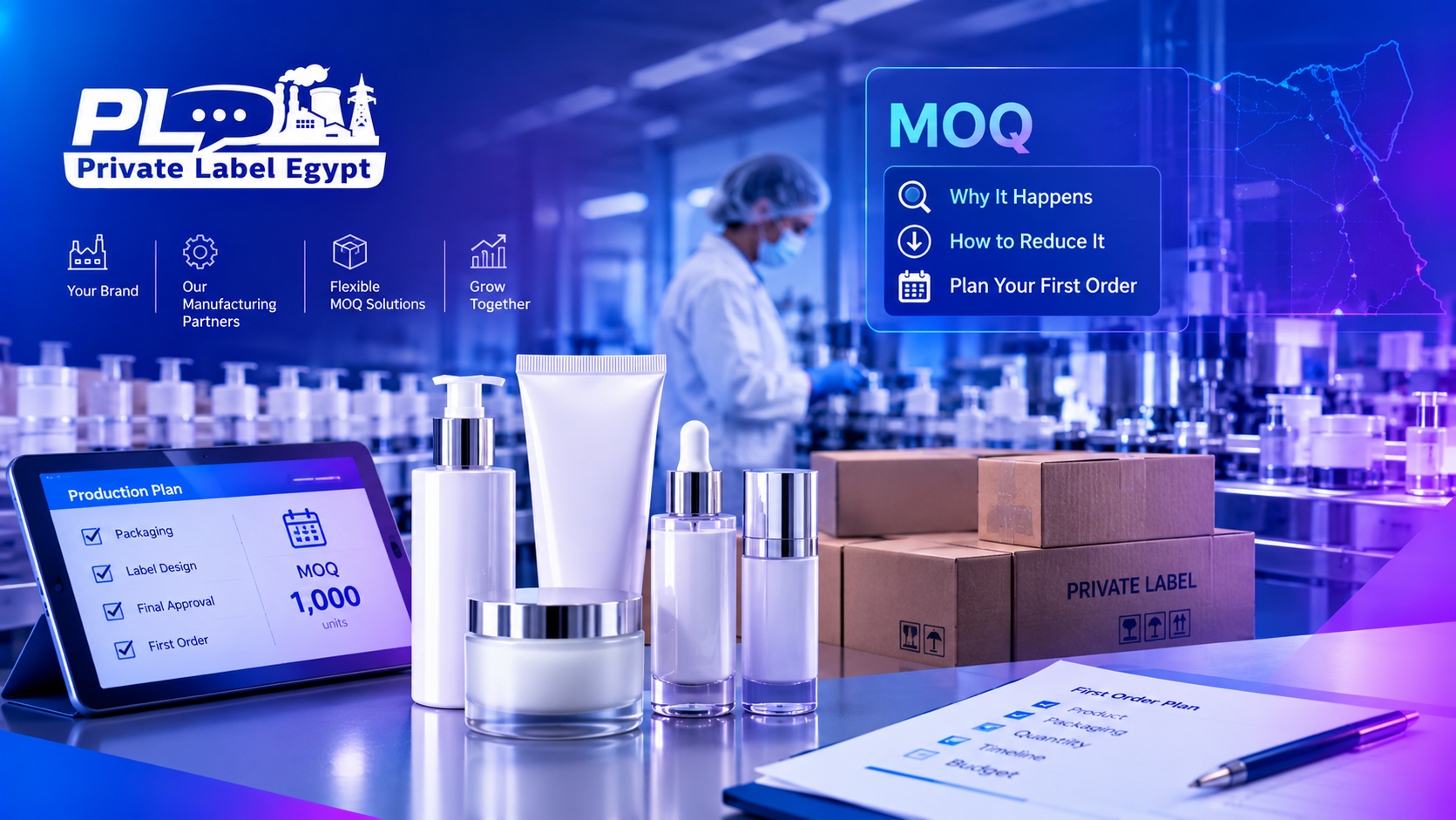
Short answer: the minimum order quantity (MOQ) is the smallest quantity a factory will accept in a single order. Factories set it because some costs are fixed whatever the order size: preparing and cleaning the line, buying raw materials and packaging in the minimum quantities their own suppliers impose, and filling a mixing tank or machine to the level it needs to work properly. The factory's MOQ is therefore usually the highest of these floors, and packaging is often the one that decides it. MOQ is frequently negotiable: stock packaging, the factory's existing formulas, fewer variants, a small trial run at a higher unit price or a longer commitment can all bring it down, and each has a price.
This guide explains what MOQ means in private-label manufacturing, why factories set it, how it differs by product type, practical ways to lower it and what each one costs you, how to plan your first order and your cash flow, the most common mistakes, and how to read the minimum run and lead time on PLEgypt's manufacturing listings and requests for quotation.
Key takeaways
MOQ is not an arbitrary number: it reflects the factory's fixed costs and the minimums its own suppliers impose on it.
Your real minimum is the higher of two floors: the formula (batch) floor and the packaging floor. Packaging is often the bottleneck.
MOQ may apply per product variant (per SKU) or to the order as a whole; ask which before comparing quotes.
Every way of lowering MOQ has a cost: a higher unit price, less differentiation, or a longer commitment.
Plan the first order around cash flow: do not tie up more money in stock than you can sell within a reasonable period.
What is the minimum order quantity (MOQ)?
MOQ is the lowest quantity a supplier will produce or sell in a single order. It can be expressed in units (pieces, bottles, cartons), in weight or volume (kilograms, litres), or as a minimum order value.
According to Alibaba.com's seller guide on MOQ and lead times (2026), there are two common forms you should tell apart:
Per-SKU MOQ: a minimum for each variant (each size, colour or fragrance) separately.
Per-order MOQ: a minimum for the total order, whatever the mix of variants.
The difference is large in practice: a minimum of 1,000 units per order lets you split them across three fragrances, while a minimum of 1,000 units per fragrance means 3,000 units for the same range.
Why do factories set a minimum order quantity?
Because part of the cost of every production run is fixed and does not shrink with the order, and the factory has to recover it. The main reasons are below; the first, second and last are drawn from Inbound Logistics (February 2025) and ShipBob (updated December 2025), and the packaging and batch-size points are explained with sources in the next subsection:
Setup and changeover: adjusting the machines, cleaning the line between products, and quality checks at the start of the run. These costs are nearly the same whether the factory produces a few hundred units or several thousand.
Raw-material minimums: the factory buys its materials from suppliers who impose their own minimums, and buying in bulk is usually cheaper. If your formula needs a special ingredient sold only in large drums, the factory will want to use enough of it.
Packaging minimums: bottles, caps, labels and boxes come from separate suppliers, each with its own minimum, and custom printing or moulding raises it.
Batch size: a mixing tank or machine has a minimum fill level for the process to work correctly.
Administration and profit: a quotation, a contract, quality documents and shipping arrangements cost the same for a small order as for a large one.
The Alibaba.com guide expresses this as a simple break-even logic: the MOQ is roughly the fixed costs divided by the margin the factory earns on each unit (the selling price minus the variable cost). The lower the factory's unit margin, or the higher its fixed costs, the higher its minimum.
Why is packaging often the bottleneck?
Because the formula and the packaging usually come from different suppliers with different minimums, and you must meet the higher of the two. A contract laboratory's guide for body care (LAEYO Labs, January 2026) gives an example: a batch of 300 kg of formula might fill only about 3,000 bottles, while the bottle supplier asks for 5,000. In that case the packaging decides your minimum, not the formula.
A guide from a Korean cosmetics sourcing company (NextPangaea, February 2025) adds that a 300 kg mixing tank usually needs at least two-thirds of its capacity, about 200 kg, to work properly, and that using the factory's existing packaging moulds allows much lower minimums than a custom mould. These figures come from Asian markets; treat them as an illustration of the mechanism, not as Egyptian norms. The actual numbers vary by factory and must be asked for in writing.
How does MOQ differ by product type?
There is no single MOQ per sector; each factory sets its own. But the drivers above point to general patterns you can use to set expectations:
| Factor | Tends to lower the minimum | Tends to raise the minimum |
|---|---|---|
| Formula | The factory's existing, ready formula | A custom formula developed for you, or a rare ingredient |
| Packaging | Standard bottles and jars the factory or its supplier keeps in stock | Custom colours, custom moulds, direct printing on the pack |
| Decoration | Printed stickers or labels | Screen printing, hot foil, printed boxes |
| Process | Simple, short processes (filling, mixing) | Long setup, tooling, multi-stage processes |
| Range | One variant, or a per-order minimum | Many sizes, colours or fragrances with a per-SKU minimum |
Broadly: products that depend on a mixing tank (creams, shampoos, detergents, sauces) are governed by batch size; products that depend on a mould or a die (plastic parts, custom packaging) are governed by tooling cost; and garments and textiles are often governed by the minimums of fabric and trims. Always ask the factory which floor controls its minimum for your product, because the answer tells you what you can change.
How can you lower or negotiate the MOQ?
MOQ is often negotiable, especially when you understand where it comes from. In practice, the minimum a factory states first is often an opening position rather than a final number. The most common strategies, and what each costs you:
| Strategy | How it lowers the minimum | The trade-off |
|---|---|---|
| Stock packaging | Removes the custom-mould or custom-print minimum | Less distinctive look; the same pack may appear on other brands |
| The factory's existing (shared) formula | No development, no special raw materials | You usually do not own the formula; competitors may sell a similar product |
| Fewer variants | Concentrates the quantity on one SKU instead of splitting it | A narrower range at launch |
| A trial run at a higher unit price | The factory accepts a smaller quantity because its margin covers the fixed costs | A higher unit cost that squeezes your margin |
| Paying setup or tooling fees separately | The fixed cost is paid upfront instead of being spread over a large order | A cash outlay at the start; clarify who owns the mould |
| Staged orders (a larger total delivered in instalments) | The factory plans production or buys materials against a known total | A firm commitment to later instalments, even if sales are slow |
| A longer contract or a demand forecast | Gives the factory visibility to plan and buy | Less freedom to switch factory; read the exit terms |
| Plain labels or stickers instead of printed boxes | Avoids the printing-press minimum | A simpler presentation on the shelf |
The same guide cites an example of a buyer who secured a trial quantity by accepting a higher unit price and committing to regular reorders, and advises building the relationship through samples before large commitments. ShipBob and Inbound Logistics add: compare several suppliers, cut slow-moving variants, and ask directly about mixing products or using leftover materials.
Practical tip: when you negotiate, ask the factory to break its quote into "setup cost" and "unit cost". Then you can see exactly what you pay for a smaller quantity, and decide whether a higher unit price or a separate setup fee suits you better.
How do you plan your first order and your cash flow?
Start with how many units you can realistically sell, not with the factory's minimum. Then compare that number with the MOQ and decide whether to negotiate the minimum down, raise your sales plan, or look for another factory. Steps that help:
Estimate sales for your first months: by channel (online store, pharmacies, wholesale), even as a rough range.
Ask for a quote at more than one quantity: the minimum, double it, and a larger quantity, so you can see how the unit cost falls with volume.
Calculate the total cash needed: formula, packaging, setup or tooling fees, samples, tests and registration, transport and storage. The unit price is only part of the bill.
Agree the payment terms in writing: factories often ask for a deposit when the order is confirmed and the balance before release; the split varies by factory, so compare it as carefully as the price.
Leave room for a second order: do not spend your whole budget on the first run. The Alibaba.com guide advises starting with a test order and reordering based on actual sales rather than committing to large stock upfront.
Check shelf life: for cosmetics, food and detergents, stock that exceeds what you can sell before expiry is a loss, not a saving.
Consider financing if needed: the Micro, Small and Medium Enterprises Development Agency (MSMEDA) makes financing available through NGOs, non-bank financial institutions and banks, subject to conditions such as a simplified feasibility study, according to Youm7's report of June 2026. Check the current conditions with the agency directly.
For regulated products, remember that registration may be per product or per variant. In cosmetics, for example, each size or fragrance may need its own listing with the Egyptian Drug Authority; see our private-label cosmetics manufacturing guide before multiplying variants.
What mistakes should you avoid with MOQ?
Comparing quotes without the same basis: one factory's MOQ may be per SKU and another's per order; one may include packaging and the other not.
Accepting the MOQ without asking why: if the bottleneck is the packaging, changing the bottle may solve it without touching the formula.
Launching with many variants: a per-SKU minimum multiplies the quantity and the cash tied up.
Looking only at the unit price: a lower price on a larger quantity is not a saving if the stock does not sell before it expires.
Commissioning a custom mould without clarifying ownership: agree in writing who owns the mould and whether you can move it to another factory.
Ignoring lead time: the minimum and the lead time go together; a larger order or custom packaging usually takes longer.
Skipping the sample: approve a sample, and ideally a pre-production sample, before paying for the full run.
How does PLEgypt show minimum run and lead time?
On the manufacturing market, every product-manufacturing listing card shows three summary facts: Minimum run, Lead time and Capacity, as the factory itself declared them. What helps you as a buyer:
"Not announced" instead of zero: if a factory has not stated its minimum run or lead time, the card says "Not announced", never zero or a blank that looks like "no minimum".
A minimum with its unit: the minimum is declared with a unit of measure (pieces, kilograms, cartons…). The market compares minimums only within the same unit, and tells you when two minimums cannot be compared, for example when one is in cartons with no stated count per carton.
Narrowing the shelf: you can filter listings by declared answers, with "at most" or "at least" limits within a unit you choose.
Price by quantity: some listings show indicative prices at several volume steps, and variants (sizes, colours, grades) can each carry their own price and minimum run. These prices are indicative; the final price is agreed in the quotation.
Side-by-side comparison: collect several listings and compare them field by field. The market only marks the differences; it does not rank or recommend factories.
Samples: some factories accept sample requests and state the sample price and how many days it takes.
From any listing you can press "Request a quote for this". Or create a request for quotation describing your product: the quantity and its unit, a budget range, a deadline, attachments, and whether the request is public or private. Offers arrive with an estimated delivery time in days, so you can compare price, minimum and lead time in one place. You can also browse open requests for quotation and the company directory.
Practical tip: state your real quantity in the request, even if it is below what you expect factories to accept. A factory that can serve a small first run will say so, and one that cannot will tell you its minimum.
Frequently asked questions
What does MOQ mean in manufacturing?
MOQ (minimum order quantity) is the smallest quantity a factory will produce or sell in a single order. It may be expressed in units, weight, volume or order value, and may apply per variant or to the whole order.
Why do factories refuse very small orders?
Because some costs are fixed whatever the quantity: setting up and cleaning the line, the minimum purchase of raw materials and packaging, and the minimum fill of a mixing tank or machine. Below a certain quantity, the order does not cover those costs.
Is MOQ negotiable?
Often, yes. The minimum can come down with stock packaging, an existing formula, fewer variants, a higher unit price, a separate setup fee, or a longer commitment. Each option has a cost, so compare them against your plan.
What is the difference between per-SKU MOQ and per-order MOQ?
A per-SKU minimum applies to each variant separately (each size, colour or fragrance), while a per-order minimum applies to the total order whatever the mix. The difference can multiply the quantity you need, so ask which one applies before comparing quotes.
Why is the packaging minimum often higher than the product minimum?
Because packaging comes from separate suppliers with their own minimums, and custom moulds and printing raise them. Your real minimum is the higher of the formula floor and the packaging floor.
How much should my first order be?
There is no fixed number. Start from a realistic sales estimate, ask for quotes at more than one quantity, calculate the total cash needed, and keep room for a second order instead of committing your whole budget to the first run.
Where can I see a factory's minimum run on PLEgypt?
On the manufacturing market, each listing card shows the minimum run, lead time and capacity as declared by the factory, or "Not announced" if the factory has not stated them. You can also state your quantity in a request for quotation and receive offers with a delivery time.
Sources
Alibaba.com Seller Blog, "MOQ and Lead Time Guide for B2B Buyers" (2026) — seller.alibaba.com
Inbound Logistics, "MOQ Meaning: Its Formula, and How To Optimize It", Amy Roach (February 2025) — inboundlogistics.com
ShipBob, "Minimum Order Quantity: How it Works & Calculation Guide" (updated 26 December 2025) — shipbob.com
LAEYO Labs, "Body Care MOQ Explained (2026): What Drives Minimums for Formula vs Packaging" (11 January 2026) — laeyolabs.com
NextPangaea, "How is MOQ Determined in Cosmetic Manufacturing?" (2 February 2025) — nextpangaea.com
Youm7, "Conditions for financing small and micro enterprises through NGOs, institutions and banks" (7 June 2026) — youm7.com
Last updated: September 2026. This guide is general information, not legal, financial or professional advice; minimums, prices and lead times vary by factory and must be confirmed in writing.